
In recent years, Samuel Beckett's Waiting for Godot (published in 1952) was staged in Yiddish, both in the US and in Israel. The Yiddish Israeli production (2015) directed by Yehoshua Sobol, altered the ending, transforming it into a play about Jewish refugees during World War II, who wait for help to escape the Nazis but eventually decide to flee Europe by themselves. I would like to explore this reinterpretation of the canonic absurd play, and its adaptation to a specific context. Sobol based his staging on a book published in 2008 by Pierre Temkine, who reads Vladimir and Estragon as French Jews hoping to be smuggled over the Spanish border, in 1943. In the show, they carry suitcases and wait for that someone named Godot to help them cross the border clandestinely. But Godot never arrives. The two characters are doomed to wait for salvation until their death (alluding to Walter Benjamin's suicide on the French-Spanish border in 1940). The most common interpretation of Waiting for Godot is that waiting is an eternal existential state, implying that Vladimir and Estragon are going nowhere. They stay just where they are, and wait for eternity. Sobol's reinterpretation of the play was thus twice subversive: not only did he base the production on Temkine's reading, but he also altered the play's ending. Vladimir and Estragon decide to leave, take their suitcases and step off the stage into the auditorium, breaking the 'fourth wall' convention. They pass through the audience and go out. To my best knowledge, this is the only staging of Waiting for Godot that exempts the two protagonists from eternally waiting.
1. The Temkines' Exegesis
From the time of the premiere, a critic had set the tone: “Godot, in an indefinite past, in rather uncertain circumstances, set them a rather imprecise appointment in an ill- defined place at an indeterminate time” (Brée, 124). Ludovic Janvier, in 1969, expressed the paradigmatic reading in his Beckett par lui-même, part of the popular series Les Écrivains de toujours:
Vladimir and Estragon, two puppets stranded in the limbo of a no man’s land where everything repeats itself – lingering words, gestures of tenderness or aversion, clowning around meant to elude suffering, visits from humanity […] – persist in expecting the unlikely rescue from an outside or a great beyond which leaves them to their own devices, trapped within their questions in the here and now. (Janvier in Suhamy, paragraph 1)
The historian Valentin Temkine, however, dissents: “One couldn’t be more systematically mistaken!” (Suhamy, paragraph 1). According to him and to his grandfather, Pierre Temkine, a French philosophy teacher, Waiting for Godot “is not the play we thought it was” (Suhamy, paragraph 1). All the categories that constitute what by common accord is called “absurdist theatre” are energetically dispatched: the play has a place, a time and its characters have a well-defined identity. The plot is set in the Roussillon region of southern France (where Beckett resided during the war), at the time of the invasion of the free zone, and the two characters Vladimir and Estragon are Jews who are waiting for the smuggler who is to save them: some Godot. In 1942, there would have been no reason for them to leave Roussillon. By 1944, they would already have been deported. The play is therefore set in the spring of 1943 precisely (Suhamy, paragraph 2).
Pierre Temkine's thesis is not entirely new, yet somehow it went unnoticed until recently. A similar interpretation was advanced by Hugh Kenner in 1973:
It is curious how readers and audiences do not think to observe the most obvious thing about the world of this play, that it resembles France occupied by the Germans, in which its author spent the war years. There existed throughout a whole country for five years, a literal situation that corresponded point by point with the situation in the play. (Kenner 30)
But then why Jewish refugees? The Temkines base their analysis first and foremost on the fact that in the draft version of the play the characters names were Vladimir and Lévy (a common Jewish name), as Mark Taylor-Batty and Juliette Taylor-Batty mention:
In his original handwritten manuscript, Beckett gave his principle characters the names Vladimir and Lévy, renaming Lévy as Estragon by the time he got to drafting the second act. The name Lévy was so commonplace in French Jewish communities that it was virtually synonymous with "Jewish" to French audiences […] Beckett, who has experienced the loss of close Jewish friends to Nazi concentration camps, perhaps rejected the overtly Jewish name in preference for a name that might be more broadly representative. (Taylor-Batty 22)
That Estragon began life as Lévy can be verified in the manuscript that was on display in 2011 during the Beckett exhibit in Paris, at the Centre Pompidou New Media Collection. It is a most striking fact—albeit “known to specialists, although no conclusion, it seems, was drawn” (Suhamy, paragraph 3). “It can be objected, however, that if the author chose to replace this name with another, quirkier one, then maybe this is an indication that he deliberately chose to move away from a historical setting” (Suhamy, paragraph 4). Yet the Temkines find additional “converging clues” in the French version of the play:
The decisive passage is found on pages 13 and 14 of the current Minuit edition, where an allusion is made to "la Roquette," a Parisian area where Talmudic schools existed from the 1900s up to the 1930s; along with mentions of images of the Holy Land, of the Dead Sea, of the crime of being born, of circumcision (Suhamy, paragraph 2).
Suhamy's article continues:
If the reference to the persecution years can presumably explain the conceptual origin of the play, must it therefore dictate the reading of the finished work? Pierre Temkine’s answer is that Beckett did not obliterate all the traces, rather he left a number of clarifying signposts; enough of them, at least, to make Waiting for Godot a historical play... Beckett crafts a metaphysical and abstract fable that is based on, and treats, a very singular historical situation. Thus he invents, according to the Temkines, a way of keeping silent on the subject. Certainly, Beckett went on, after Godot, in an increasingly abstract direction, as indeed his early work was very much rooted in setting, with an abundance of historical detail. But Godot is at the crossroads of this evolution, and remains inscribed in history. (Suhamy, paragraph 2)
Beckett must therefore have sought and found a certain distance so that the readers or spectators who lived through the events would not recognise them on any conscious level but, rather, would live them from within, so to speak. According to Pierre Temkine in a beautiful essay titled “What not saying anything does”, by erasing the name Lévy, Beckett refuses “to show the Jew as a Jew. For he is neither a rampant menace, as fantasised by some, nor the quintessential victim, as erected by others. Beckett cuts straight to the flesh and bone: these people are men. They might inspire compassion, disgust or boredom, but not because of their origin” (Suhamy, paragraph 5). An author who treats such a subject can no longer designate or name his characters. To designate, to name, means to turn in, to destroy. The author now needs a different audience: one that can no longer think it understands because it recognises or identifies. The subject must be left in penumbra, in order to prevent the audience from designating too. The idea is to respect the characters by neither classifying nor labelling them, says Pierre Temkine (Suhamy, paragraph 5).
But if this is the case, then why lift the veil? Isn’t restoring the play to its tacit source a betrayal of the author’s intentions? Pierre Temkine’s answer to this is that the play has become a classic that has been gone over almost too much, and that its clown-esque staging is outdated. According to him, it is necessary to renew with the historical background in order to breathe new life into the potentialities of staging and acting, because there is a great gap between a road in an imaginary country and one in a place where the militia or the Resistance can burst in at any moment. Abstract angst becomes concrete fear and the stakes become vital. Above all, the situation presented in the play is no longer doomed to endless repetition, as warranted by the absurdist reading that has been imposed on the play. It is true that Godot does not show up: but is this surprising in the context of war? Perhaps he will come tomorrow. As Beckett writes in a contemporary text, L’innommable: “Nothing has changed since I’ve been here, but I daren’t conclude that nothing will ever change” (Suhamy, paragraphs 4-7).
What the Temkines, grandfather and grandson, have in fact achieved is a new interpretation of one of the most famous plays in contemporary repertoire. What remains to be done is to spread the news. Indeed, in the last decade a number of productions of Waiting for Godot have been based on their book: among others, the 2010 production by Le Théâtre de l’Eskabo de Saint-Étienne, presented at the Avignon Festival and directed by Patrick Reynard, and the 2012 production in Hamburg at Deutsches Schauspielhaus, directed by Henrike Zöllner, as well as the 2016 Laurent Fréchuret's staging at the Théâtre de la Croix-Rousse in Lyon. In 2014 Ivan Panteleev's production at the Deutsches Theatre Berlin was crowned “among the 10 ‘most remarkable’ 2014 productions” and “fittingly has been awarded the Theatertreffen prize” (Jacobson, 2015). In an interview with Rivka Jacobson, the director reveals his source of inspiration:
Panteleev: There is a book by Pierre Temkine called “Waiting for Godot. The Absurd and The Histoy”. [sic] The authors develop on the basis of quotations from the play and historical researches a theory, which prove that the two characters Vladimir and Estragon are Jews during the II World War, who are waiting for the smuggler, who is to save them: some Godot… For me it was very important that Vladimir and Estragon are not victims, and that their waiting of someone who doesn’t come, not today, not tomorrow and not even 60 years later [sic], stands for liberation and affirmative try to attempt the impossibility. To be free means not to have all the possibilities. It means to crossover the space of the possibilities in order to be ready for the impossible; and this is what art has to do – to wish, to crave and to desire the impossible. (Jacobson, 2015)
I will get back to Panteleev in the conclusion of my discussion.
2. Vladimir and Estragon at Yiddishpiel: Nonwaiting for Godot
Yiddishpiel is the Israeli Yiddish Theatre, established in 1987 in response to a vital need to re-establish the lost honour of the Yiddish language and its culture, and to revive it. Since 1988 the theatre has staged a rich and vibrant repertoire of more than 140 shows. Many of them are based on plays written in Yiddish in Eastern Europe in the nineteenth century and early twentieth century, but also on translations of worldwide drama. With surtitles in Hebrew and English, the theatre has earned international recognition and prizes.
A production of Beckett's play by Yiddishpiel was a daring artistic decision, since most of its spectators are senior citizens, who expect some Jewish nostalgia: stories about the diasporic past, beloved Yiddish songs, and Jewish humor. The abstract plot of Waiting for Godot was unexpected, and at the same time, challenging. The majority of the audience came from Eastern Europe, their parents having lived there during World War II and many were Holocaust survivors. For them, Yehoshua Sobol's interpretation was compelling. It was a multilingual production, where Vladimir and Estragon spoke Yiddish, while Podzo spoke French, his servant Lucky spoke a mixture of languages that turned into gibberish, and the boy from the other side of the border spoke Spanish.
Dori Engel as Vladimir and Yuval Rappaport as Estragon in Waiting for Godot, by Samuel Beckett
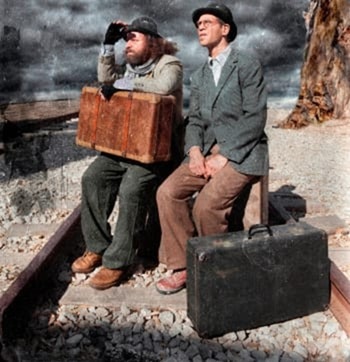
Directed by Yehoshua Sobol. July 2015. Yiddishpiel Theatre, Tel-Aviv
Photo by Gérard Alon
Sobol's interpretation of the play was subversive, as the website of the Yiddishpiel Theatre in Tel Aviv put it:
A revolutionary interpretation which binds the play's plot and his heroes to the place and time that bestowed on Beckett the inspiration to write the play: Southern France, late winter and early spring of 1943. Embedding the play's plot within concrete location and time unveils a new layer of the play and shatters everything you thought about the classic play. (Yiddishpiel Website)
In an interview, Sobol states that Vladimir and Estragon must flee a dangerous and indifferent Europe for Israel (though not yet an independent state in 1943). They therefore pass through the audience and go out. Having them abandoning the wait for Godot is an optimistic statement about the possibility of a salvation of sorts and of Jewish independence. Given the profile of Yiddishpiel's audience, says Sobol, he could not let Vladimir and Estragon wait for Godot until their death. Jewish refugees with suitcases are, in Israeli terms, the most loaded sign: they encapsulate the image of the displaced, the victim, the eternal Wandering Jew. Shimon Levy remarks that “[I]n the depth of Israeli experience are traces of Jewish anxieties, remains of the fear of expulsion, of enforced wanderings… These suitcases allude to the Jew within the Israeli, people who depend on suitcases” (Levy 2016, 63-4). The suitcase thus reveals the Israeli collective subconscious. Levy asserts that the historical setting of the Yiddishpiel production triggered these fears in the Israeli audience:
Sobol's interpretation of WFG [Waiting for Godot], following some 60 plays he has written, directed and performed successfully world-wide, exposes a profound layer of the Jewish, post-Holocaust version of the genuine Israeli anxiety vis-à-vis threats of annihilation by the Arab world and the Iranian nuclear projects. Are the Israelis, in their own country, established soon after the Holocaust, still in great danger? (Levy 2017, 320)
Therefore, the interpretation conveys the existential need for a safe home:
This explicit disregard for Beckett's stage instruction has only one justification. [Vladimir and Estragon] abandon their doubtful salvation from the outside at the meeting place and take their fate into their own hands. They have a choice and they go for it. […] Sobol’s Godot is hence neither a Messiah nor an open offstage metaphor but a concrete character who may yet save Jewish refugees, anxiously awaiting him. (Levy 2017, 322)
Sobol's decision prompts further discussion regarding the status of dramatic ends. “The end”, particularly of canonic plays, is part of a historical patrimony. Intriguingly, Shimon Levy also mentions a totally opposed alteration of Waiting for Godot's ending: in a production in Baghdad, Godot did actually arrive. Such a scandalous arrival requires a very profound rationale, even more than having Vladimir and Estragon quit. The director Ivan Panteleev made it clear: “For me was very important that Vladimir and Estragon are not victims” (Panteleev in Jacobson, 2015); yet he did not let them flee. Sobol took this hope a step further: his staging has succeeded in historically and geographically locating Beckett's play and it reveals a strategy of reinterpreting European theatre. However, altering the end of the play seemed to me rather shocking. As a theatre scholar, I viewed this change as a distortion, and nothing less than a sacrilege. For the Yiddishpiel audience it was probably the right decision.